Build vs. buy: when LLMs justify replacing SaaS tools
The TCO math on building internal tools with AI coding assistants vs. paying per-seat SaaS. A worked example with real ₹ costs shows when DIY wins—and the hidden maintenance trap.
The reality: most in-house tools cost more over three years, fail to stay maintained, and leave your team stuck when the original builder leaves. But there are narrow cases where building wins—and the math is precise enough to decide.
When the question actually makes sense
Teams on Reddit and in tech communities have asked this directly: "Anyone used LLMs to build in-house tools just to ditch an expensive SaaS?" The honest answer isn't "always no" or "always yes"—it's "if your SaaS spend is high, scope is narrow, and you accept the maintenance burden."
The three conditions that matter:
- Below that, the build cost eats the savings.
- You have a senior engineer who can own the tool for 3+ years. Not a contractor, not a junior. Someone who understands architecture, security, and the business logic.
- The tool's scope is stable and narrow. Internal dashboards, reporting layers, basic CRM for a small team, ticketing for ops. Not customer-facing, not payment-handling, not compliance-heavy.
If all three are true, keep reading. If not, the SaaS vendor's feature velocity and support will outlast your patience.
The real cost: a worked example
Let's say you're a 50-person distributor paying ₹20 lakhs/year for a CRM (Zoho, Pipedrive, or similar). You want to build an in-house system instead.
Build cost (Year 1):
- Senior engineer salary for 10 weeks: ₹18 lakhs
- Database design, architecture review, security audit: ₹2 lakhs
- Hosting (AWS, DigitalOcean): ₹1.5 lakhs/year
- Bug fixes and refinement (first 6 months post-launch): ₹5 lakhs
- Year 1 total: ₹26.5 lakhs
Ongoing cost (Years 2–3):
- Hosting: ₹1.5 lakhs/year
- Maintenance, schema changes, security patches: ₹5–6 lakhs/year (one engineer at 20–30% capacity)
- Years 2–3: ₹6.5–7.5 lakhs/year each
3-year total: ₹40–42 lakhs
Compare to SaaS:
- Year 1: ₹20 lakhs
- Year 2: ₹22 lakhs (typical 10% annual increase)
- Year 3: ₹24 lakhs
- 3-year total: ₹66 lakhs
On paper, building saves ₹24 lakhs. But this assumes:
- Your engineer doesn't leave (if they do, add ₹8–10 lakhs for knowledge transfer and stabilization).
- No major security incidents or data loss (one breach costs ₹10+ lakhs in incident response and remediation).
- No feature creep (users will ask for reports, integrations, mobile access—each costs ₹2–4 lakhs).
- No API deprecations from your dependencies (PostgreSQL, Node.js, auth libraries all evolve).
Real-world 3-year cost: ₹50–60 lakhs. The gap narrows.
| Cost item | SaaS (Zoho/Pipedrive) | Build in-house | |
|---|---|---|---|
| Year 1 license | ₹20 lakhs | ₹0 | |
| Build cost (senior eng, 10 weeks) | ₹0 | ₹20 lakhs | |
| Infrastructure (hosting, DB) | Included | ₹2 lakhs/yr | |
| Maintenance & bug fixes (Year 1) | Included | ₹5 lakhs | |
| Year 1 total | Yes₹20 lakhs | ₹27 lakhs | |
| Year 2 license + maintenance | ₹22 lakhs | Yes₹7 lakhs | |
| Year 3 license + maintenance | ₹24 lakhs | Yes₹7 lakhs | |
| 3-year total | ₹66 lakhs | Yes₹41 lakhs |
Realistic scenario: replacing a mid-market CRM with an in-house system
Five questions to ask before you build
1. Is your annual SaaS spend above ₹15 lakhs? Below that, the build cost rarely breaks even. A ₹10 lakh/year tool takes 2–3 years to pay back, and by then you've spent ₹15–20 lakhs on maintenance.
2. Do you have a senior engineer available for 8–12 weeks full-time? Not a junior, not part-time. Someone who can own architecture, database design, security, and API decisions. LLMs accelerate scaffolding, but they don't replace judgment. If you're pulling someone off a revenue-generating project, the opportunity cost is real.
3. Is the tool's scope narrow and stable? Safe bets: internal dashboards, reporting layers, basic CRM for a small team, workflow automation, data pipelines. Risky bets: customer-facing tools, anything handling payments, systems requiring audit trails or compliance. The latter need professional maintenance and liability insurance.
4. Can you commit to 20–30% ongoing maintenance for 3+ years? This is the trap. After launch, the tool needs schema migrations, security patches, dependency updates, and feature requests. Most teams underestimate this. Budget one engineer at 1–2 days per week, forever.
5. Does the SaaS vendor lack a critical feature? Not "it would be nice to have." Something that blocks your workflow today and the vendor has no roadmap for. If you're building because you want to customize, you're building for the wrong reason—you'll spend more on customization than the SaaS license costs.
- Is annual SaaS spend > ₹15 lakhs?Below this, the build cost rarely pays back in 3 years.
- Do you have a senior engineer available for 8–12 weeks?Not a junior, not part-time. Someone who can own architecture and security decisions.
- Is the tool's scope narrow and stable?CRM, ticketing, dashboards: yes. Payment processing, compliance-heavy: no.
- Can you commit to 20–30% ongoing maintenance for 3 years?Schema changes, security patches, feature requests. Budget this explicitly.
- Does the SaaS vendor lack a critical feature you need?Not 'it would be nice'; something that blocks your workflow today.
Use this to decide if building makes sense for your team
Common mistakes that sink in-house tools
Underestimating maintenance. Teams build in 10 weeks, launch, then watch the tool decay. A custom tool requires the same care as a production system: monitoring, backups, security patches, and schema migrations. Most teams don't budget for this.
Scope creep. The tool launches with a CRM. Then users ask for reporting. Then integrations. Then a mobile app. Each request adds 2–4 weeks and ₹2–3 lakhs. By Year 2, you're maintaining a system that's grown 3x beyond the original spec.
Losing the original builder. If the engineer who built the tool leaves, you lose institutional knowledge. The next engineer will rewrite parts of it. Budget ₹8–10 lakhs for knowledge transfer and stabilization.
Choosing the wrong stack. Teams pick trendy frameworks (Next.js, Remix, FastAPI) because LLMs know them well. But if your team doesn't know the stack, maintenance becomes expensive. Stick to what your team already uses.
Skipping security and compliance. A SaaS tool handles GDPR, SOC 2, and data residency. Your in-house tool doesn't. If you're handling customer data, you need encryption, audit logs, access control, and regular security audits. Budget ₹3–5 lakhs upfront, ₹1 lakh/year ongoing.
How to decide: the decision tree
If annual SaaS spend < ₹12 lakhs → Buy SaaS. The build cost doesn't pay back.
If annual SaaS spend ₹12–20 lakhs AND you have a senior engineer available AND scope is narrow → Consider building. The 3-year TCO is close; build only if you're confident in maintenance.
If annual SaaS spend > ₹20 lakhs AND the vendor lacks a critical feature AND you can commit to maintenance → Building may win. But only if you're solving a real business problem, not just saving money.
If the tool is customer-facing or handles payments → Always buy SaaS. The liability and compliance burden outweigh the cost savings.
Where LLMs actually help (and where they don't)
LLMs like Cursor or GitHub Copilot accelerate the scaffolding phase: database schema, CRUD endpoints, form validation, and boilerplate. They reduce the time from 12 weeks to 8–10 weeks. But they don't reduce the maintenance burden—that's still 20–30% of an engineer's time for three years.
LLMs also struggle with:
- Architecture decisions (they'll suggest patterns, but you need judgment).
- Security (they generate code that compiles, not code that's secure).
- Testing (they write tests, but not comprehensive ones).
- Documentation (they generate it, but it's often wrong or outdated).
The real win: LLMs let a single senior engineer build what would normally take a team of two. That's valuable, but it doesn't eliminate the maintenance cost.
When to use an ERP instead of building
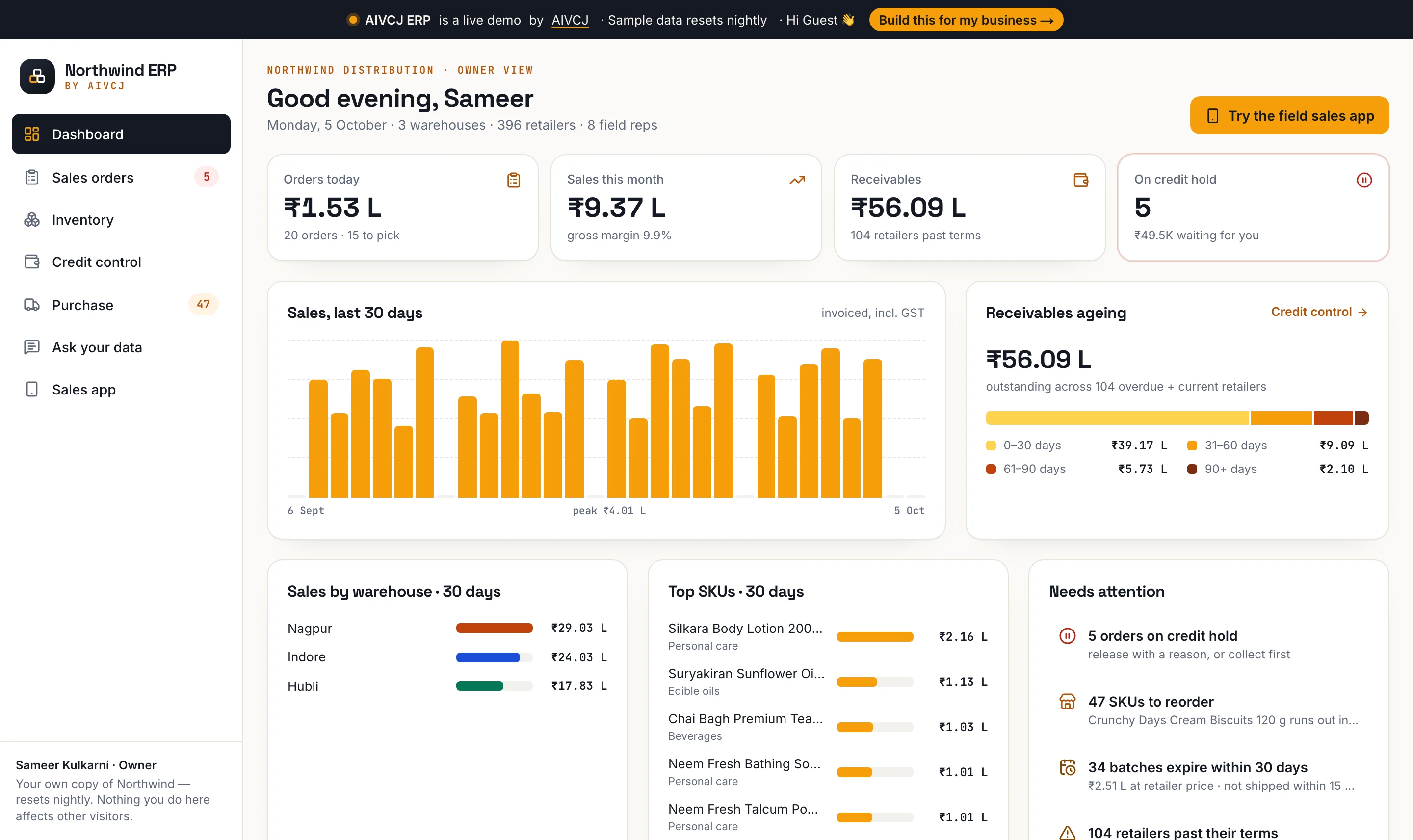
If you're a distributor, manufacturer, or wholesaler considering building a custom inventory or order management system, stop. An ERP like AIVCJ's Inventory, Credit & Orders solution handles multi-warehouse stock, batch and expiry tracking, purchase and sales orders, customer credit limits, and GST invoicing. Building this yourself costs ₹30–50 lakhs and requires ongoing maintenance for compliance and tax law changes.
See how it works in a live demo of a sample FMCG distributor with 3 warehouses, 396 retailers, and 8 field reps. The demo shows offline field ordering, credit control in code, and plain-English data queries—features that would take months to build and maintain.
The checklist
Before you commit to building:
- Annual SaaS spend is > ₹15 lakhs
- You have a senior engineer available for 8–12 weeks full-time
- The tool's scope is narrow and stable (not customer-facing, not payment-handling)
- You can commit 20–30% of an engineer's time to maintenance for 3+ years
- The SaaS vendor lacks a critical feature (not just a nice-to-have)
- You've budgeted for security, testing, and documentation
- You have a plan for knowledge transfer if the original builder leaves
- You've stress-tested the 3-year TCO with realistic maintenance costs
If you check all seven boxes, building may pencil out. If you check fewer than five, buy SaaS and spend the saved time on your core business.
Sources
Primary sources this article relies on. Rules and rates change — check the source before you act.
- 01Anyone used LLMs to build in-house tools just to ditch an expensive SaaS? How’d that go?r/developersIndia · accessed Oct 8, 2026
- #build vs buy
- #llm tools
- #saas cost
- #internal tools
- #tco analysis
Frequently asked questions
01How much faster do LLMs make internal tool development?
02What's the break-even point for building vs. buying?
03Why do most internal tools fail after launch?
04Can we use LLMs to build a tool and then hand it off?
05What kind of tools are safe to build in-house?
ERP — Inventory, Credit & Orders
Stock, credit sales, POs and SOs — in one clean system.
Keep reading
 ERP & Operations
6 min read
From WhatsApp photos to a live order book: an ERP and offline field app for distributors
AIVCJ ERP replaces the Tally + Excel + WhatsApp loop: a field app that takes orders without signal and never syncs twice, credit holds decided in code, FEFO picking with GST invoices, and plain-English questions answered by a read-only query you can see. Measured with a two-phone sync test and a blind NL-to-SQL set.
Read more5 min read
Block-based CMS with AI translation: our stack and trade-offs
We built a headless CMS with block editor, AI translation to 10 languages, and SEO tooling on PostgreSQL. Here's why we rejected SaaS and what we'd do differently.
Read more1 min read
Choosing an ERP for credit-based distribution businesses
In distribution, profit is made in purchasing and lost in receivables. What to demand from an ERP when most of your sales happen on credit.
Read more