What is RAG — and when does your business actually need it?
Retrieval-augmented generation lets AI answer from your own documents instead of guessing. Here is how it works, where it shines, and the signs you are ready for it.
Large language models are remarkable writers and terrible librarians. Ask one about your leave policy, your product's warranty terms or last quarter's pricing and it will produce a confident, fluent — and frequently wrong — answer. Retrieval-augmented generation (RAG) fixes that by giving the model the right pages to read before it answers.
How RAG works, in plain terms
A RAG system has two halves. The indexing half reads your documents, splits them into passages, and stores a numeric "meaning fingerprint" (an embedding) for each passage in a vector database such as PostgreSQL with pgvector. The answering half takes a user's question, finds the passages whose meaning is closest, and hands them to the model with one instruction: answer only from these, and cite them.
- Ingest: PDFs, Word files, spreadsheets, web pages and database rows are cleaned and chunked.
- Embed: each chunk becomes a vector that captures what it is about.
- Retrieve: a question is embedded the same way; the nearest chunks are fetched, often combined with keyword search.
- Generate: the model writes an answer grounded in those chunks, with citations back to the source.
Why not just fine-tune a model?
Fine-tuning teaches a model a style or a narrow skill. It is a poor way to teach it facts that change — prices, policies, inventory, contracts. RAG keeps knowledge in a database you control: update a document and the very next answer reflects it. You also get citations, access control per document, and the ability to switch models without retraining anything.
Five signs your business is ready for RAG
- Your team answers the same questions from the same documents every week.
- Critical knowledge lives in PDFs and shared drives that nobody searches well.
- Customers wait hours for answers that already exist in your manuals.
- New hires take months to become productive because "it's all somewhere".
- You need answers to respect permissions — not everyone should see everything.
What makes a RAG system production-grade
A weekend prototype can impress in a demo and fail on day three. The difference is engineering discipline: chunking tuned to your document types, hybrid retrieval, permission filters applied at query time, refusal when sources are missing, and — most importantly — an evaluation set of real questions with known good answers, re-run every time a prompt or model changes.
Where to start
Pick one high-volume, well-documented workflow — HR policy questions, product support, or internal SOPs. Collect fifty real questions. Build, measure, then expand. That is exactly how we run our RAG engagements, and why our assistants stay accurate after launch.
- #RAG
- #pgvector
- #AI strategy
Frequently asked questions
01Is RAG the same as a chatbot?
A chatbot is the interface; RAG is the technique that makes its answers grounded in your documents rather than the model’s memory.
02Do I need a separate vector database?
Not necessarily. PostgreSQL with the pgvector extension handles millions of passages and keeps your data in one familiar database.
AI & RAG Applications
Assistants that answer from your data — and cite it.
Keep reading
 ERP & Operations
5 min read
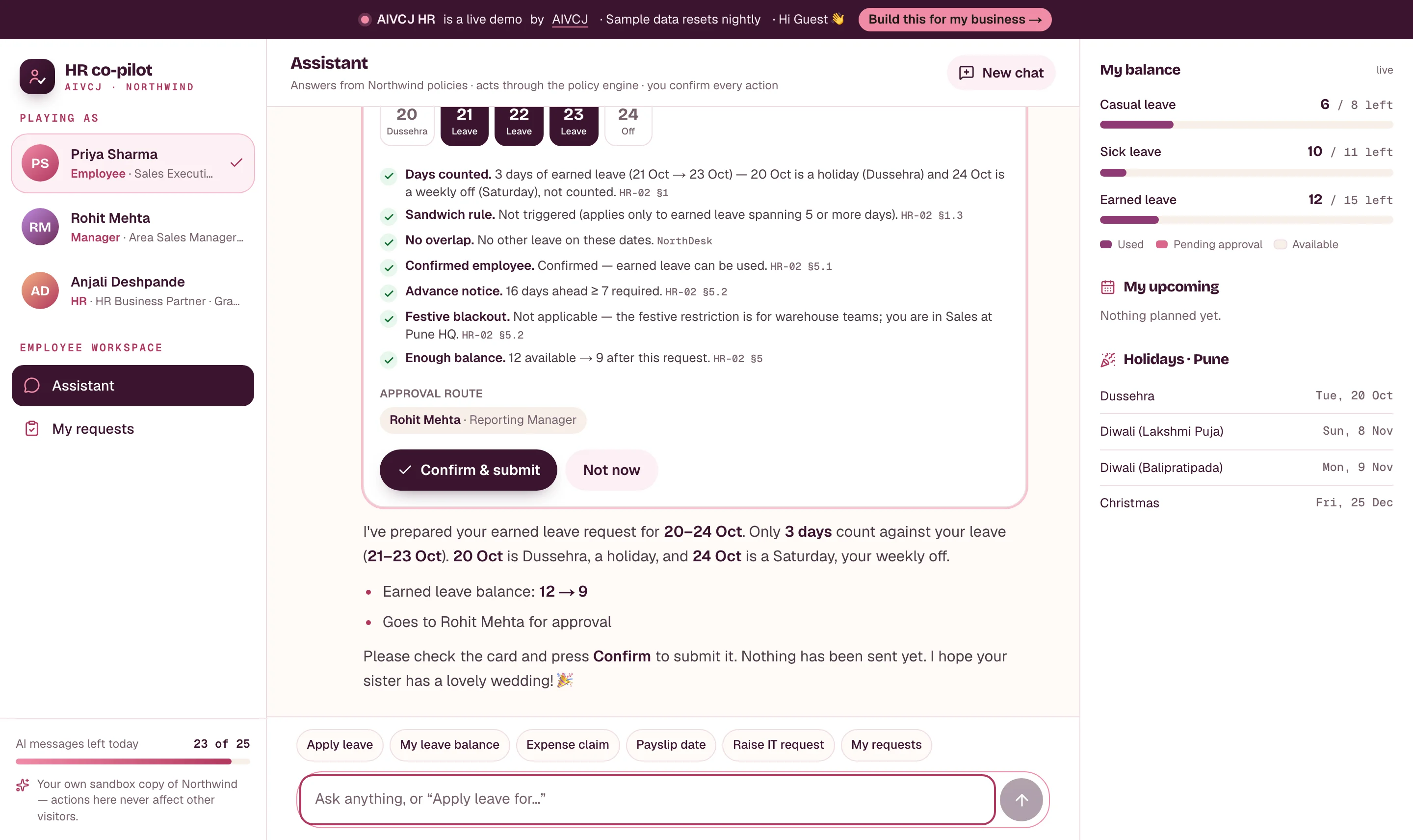
From chatbot to co-worker: building an HR assistant that takes actions safely
AIVCJ HR doesn't just answer leave questions — it applies leave, routes approvals and drafts HR letters. Here is how we let an AI act without letting it make the rules: a policy engine in code, a confirmation card before every action, role permissions and an audit log. Measured on a scripted and a blind test set.
Read more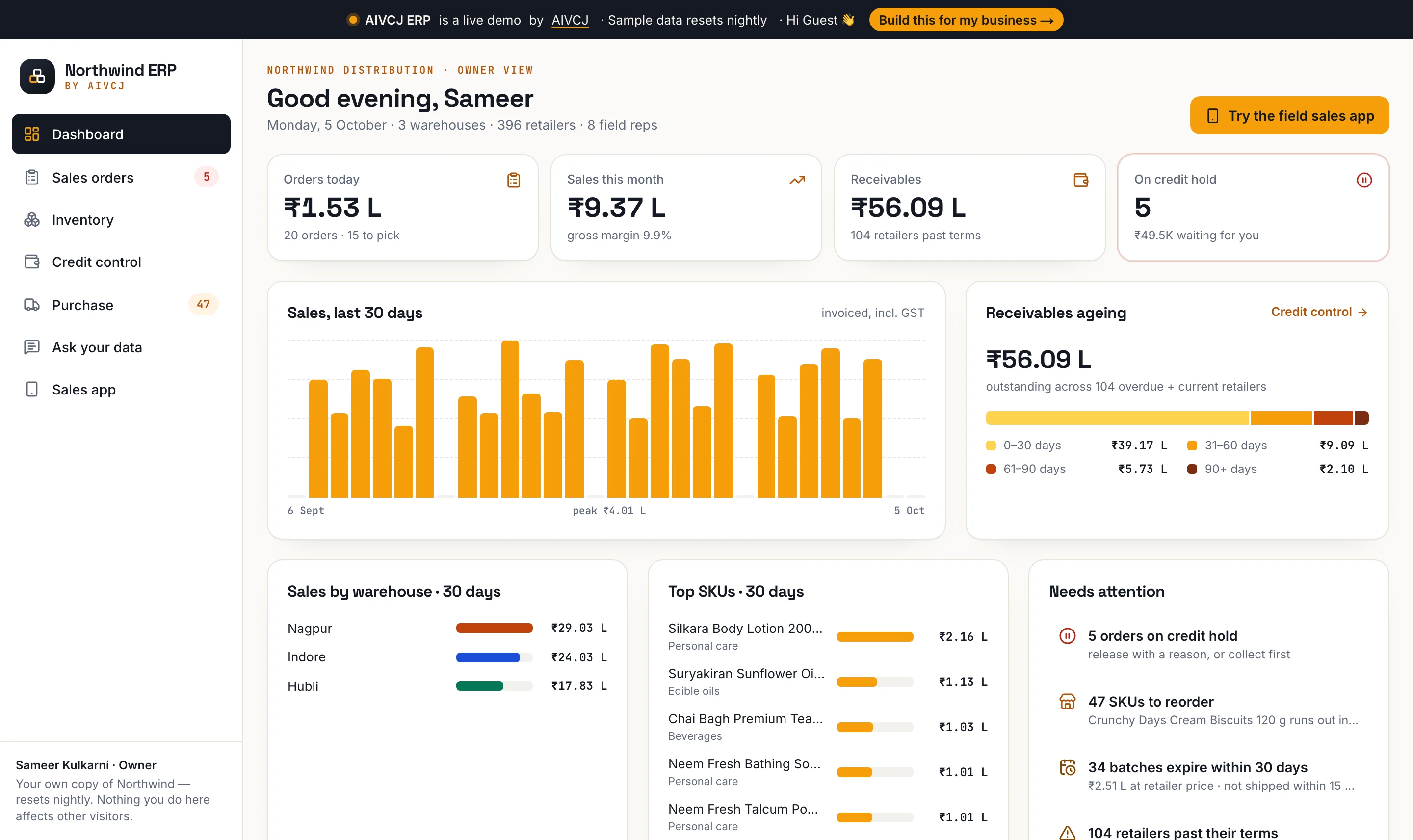 ERP & Operations
6 min read
From WhatsApp photos to a live order book: an ERP and offline field app for distributors
AIVCJ ERP replaces the Tally + Excel + WhatsApp loop: a field app that takes orders without signal and never syncs twice, credit holds decided in code, FEFO picking with GST invoices, and plain-English questions answered by a read-only query you can see. Measured with a two-phone sync test and a blind NL-to-SQL set.
Read more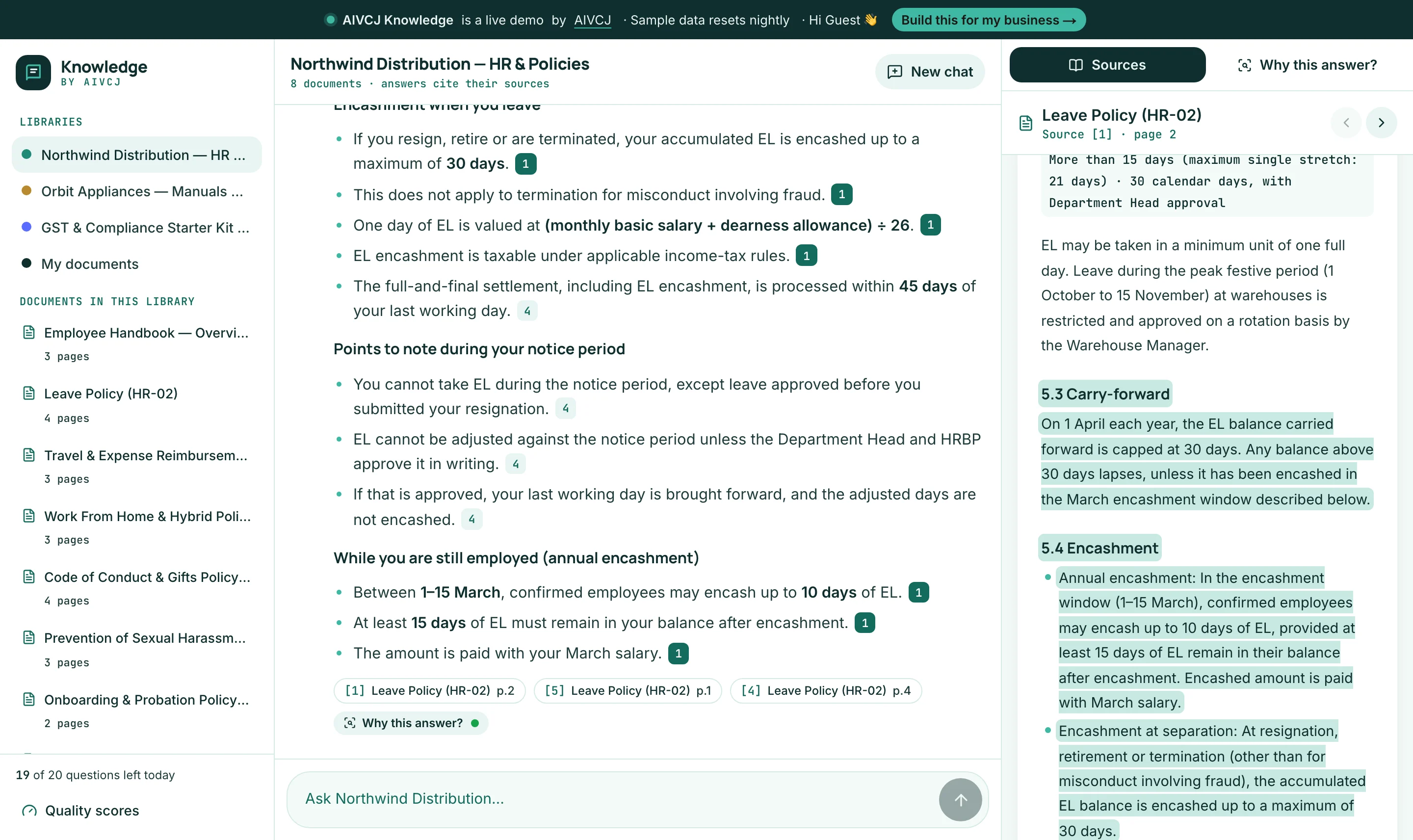 AI & RAG
4 min read
Why most company chatbots hallucinate — and how we built one that cites its sources
A behind-the-scenes look at AIVCJ Knowledge: hybrid retrieval, query planning, a grounding check on every answer, and two public test sets — including a blind one written the way real people type. Try it live on sample HR, product and GST documents, or your own PDF.
Read more